
Table of Contents
- Phase 1: Discovering the potential
- 1.1 Mapping surplus resources
- 1.2 Identifying industrial symbiosis opportunities
- 1.3 Calculating the circularity index
- Phase 2: Impact estimation and implementation roadmap
- Phase 3: Implementing the synergies
- Conclusions
Agro-urban-industrial symbiosis is an advanced circular economy strategy that makes it possible to optimise resource use, reduce waste and improve territorial resilience through collaboration between productive sectors. This technical article describes a three-phase methodology for implementing symbiosis projects: discovering the potential, impact estimation and planning, and implementation of synergies. Each phase integrates technical tools, participatory processes and evaluation mechanisms that make it possible to transform waste into resources, generate economic value and improve the environmental performance of the territory.
Phase 1: Discovering the potential — Flow mapping and identification of synergies
The aim of the first phase is to identify and quantify agro-industrial and urban waste streams that can be converted into resources through industrial symbiosis. This stage forms the technical basis of the project, as it provides the information needed to understand the territorial metabolism.
1.1 Mapping surplus resources
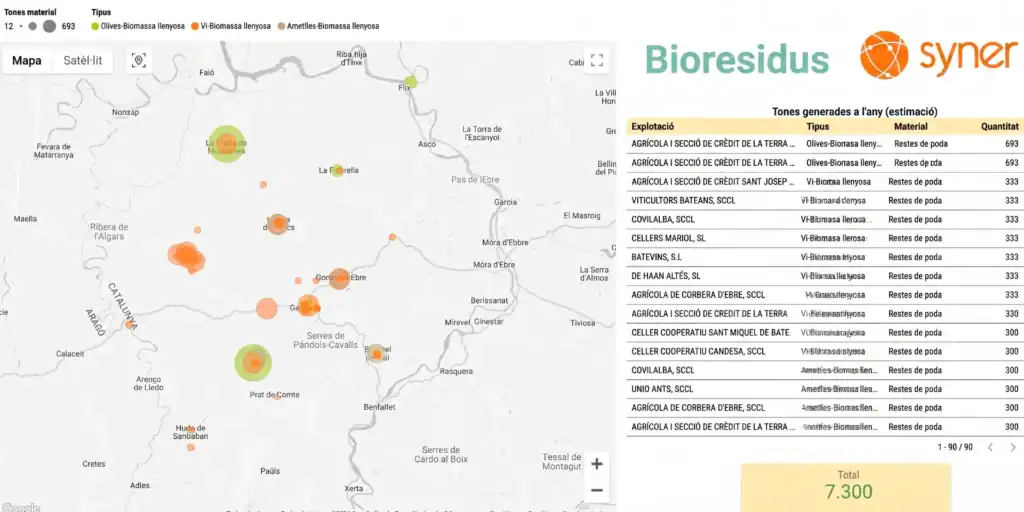
The objective is to map the ecosystem’s surplus resources and the companies connected to them, whether as providers or recipients of those resources.
To do this, it is necessary to gather information from different sources in order to provide this overall snapshot of activities and their waste streams.
Ultimately, with this information, facilitators should be able to answer questions such as:
COMPANIES: Which companies are located in my territory? What do they do? Where are the companies that generate the most waste or consume the most water or energy located? What is their turnover?
WASTE: What types of waste are generated in my territory — industrial, agricultural and urban? What is the ranking of waste streams? Which companies generate them? What is currently done with them?
WATER: What is the level of water consumption? What is the source? Which are the highest consumption points? How much wastewater is generated? Where is it treated, and with what treatment systems? What is done with the reclaimed water?
ENERGY: Which companies have the highest energy consumption? Which companies could potentially provide surplus heat? Which could potentially use that heat? etc.
The result is a map of the territorial metabolism showing the material, energy and water flows of the productive system.
1.2 Identifying industrial symbiosis opportunities
The information collected allows us to obtain a snapshot of what exists and what could theoretically be done with it, based on objective data.
Through interviews or consultations with key stakeholders in the territory, it is possible to transform this objective data into viable BUSINESS OPPORTUNITIES of interest to companies and economic development agents, through collaboration based on symbiosis. Information such as policy objectives, business capabilities and previous experience is essential for identifying the best opportunities.
The result is a potential list of opportunities to be developed, validated by the key stakeholders in the territory.
Discovering the potential is a task that requires a high level of specialisation and knowledge, and is usually entrusted to companies specialising in the development of these opportunity maps.
1.3 Calculating the circularity index
The circularity index measures the proportion of recycled materials in relation to the total amount used, excluding exports. This indicator makes it possible to:
- Assess current efficiency in the use of resources.
- Establish a baseline for the territory.
- Estimate potential improvements resulting from symbiosis.
Calculating the index provides a key indicator for measuring the transition towards a circular model and the efficiency of industrial symbiosis initiatives.
Phase 2: Impact estimation and implementation roadmap
Once the opportunities have been identified, the second phase assesses the benefits derived from their implementation and defines the operational strategy: If the identified opportunities were implemented, what would the environmental, economic or social benefits be?
2.1 Impact estimation
The assessment is carried out according to Life Cycle Assessment (LCA) criteria and includes three dimensions:

Economic impact
- Value of reused materials.
- Savings in raw materials.
- Reduction in waste management costs.
Environmental impact
- Reduction of waste sent to landfill.
- Reduction of CO₂ emissions.
- Water and energy savings.
Social impact
- Strengthening of the productive fabric.
- Job creation.
- New business opportunities.
These indicators make it possible to quantify the contribution of symbiosis to the sustainable development of the territory.
2.2 Designing the roadmap
The roadmap defines the action plan for implementing the identified synergies. It must specify:
- Specific actions to be carried out.
- Responsible parties.
- Implementation schedule.
- Required resources.
- Monitoring methodology.
This document acts as an operational guide for the transition from planning to execution.
Phase 3: Implementing the synergies — Project execution
The third phase involves direct work with companies to turn the identified opportunities into reality.
3.1 Support for companies
The industrial symbiosis facilitator plays a central role, supporting the implementation of synergies and promoting the adoption of circular practices.
The main mechanisms are:
a) Individual visits
These make it possible to:
- Carry out resource efficiency audits.
- Collect detailed technical information.
- Propose collaborative solutions.
b) Group sessions
Business workshops:
- Encourage creativity.
- Facilitate networking.
- Generate new opportunities for collaboration.
These dynamics enable companies to understand the benefits of the circular economy and develop joint ideas.💡
c) Value proposition
The value proposition is the final technical document, which includes:
- Business plan.
- Feasibility analysis.
- Technical assessment.
- Economic study.
- Environmental benefits.

This document serves as the basis for companies to implement the synergy autonomously.
Conclusions
The implementation of agro-urban-industrial symbiosis projects requires a structured methodology based on technical analysis, business participation and strategic planning. The three phases described — discovering the potential, impact estimation and implementation — are independent phases, but it is recommended that they be sequential: first mapping in order to calculate impacts before implementing without this overall strategic vision. Let us remember that they make it possible to:
- Transform waste into resources.
- Reduce operating costs.
- Reduce environmental impacts.
- Generate employment and territorial value.
- Increase economic resilience.
Industrial symbiosis therefore represents an efficient tool for moving towards circular, sustainable and competitive territories.