

Table of contents
- The energy challenge of industrial estates
- Energy symbiosis: from individual management to shared management
- The industrial estate as a local energy system
- Closed distribution networks and energy symbiosis
- Regulatory barriers to the development of closed networks
- Governance and collective energy management
- The El Goro case: an industrial estate-scale energy infrastructure project
- Expanding the grid or using it better: complementary strategies
- Towards industrial estates as energy symbiosis nodes
The energy challenge of industrial estates
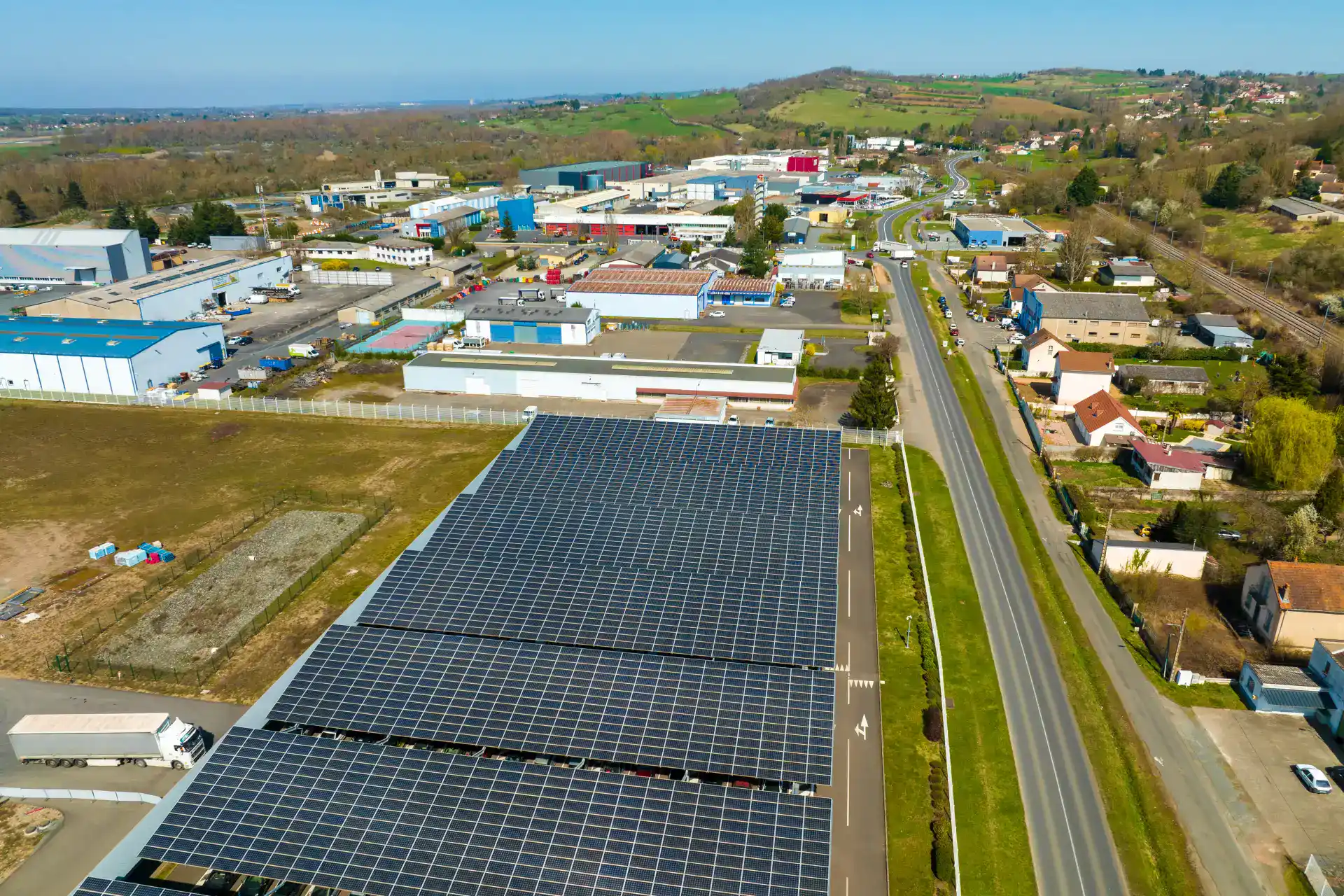
Industrial estates concentrate a significant share of economic activity and energy consumption within a territory. In relatively small areas, dozens or hundreds of companies are grouped together with significant electricity and thermal energy needs, different consumption profiles and, at the same time, large roof areas, car parks and plots suitable for hosting renewable generation, storage and other energy infrastructure.
This combination makes industrial estates particularly suitable spaces for moving towards a more distributed energy model. Where demand is concentrated, there is also a clear opportunity to produce energy close to where it is consumed, share infrastructure and coordinate energy needs between companies.
However, this potential contrasts with one limitation: the lack of available capacity in electricity grids, both due to insufficient supply capacity and insufficient capacity to feed generation into the industrial estate itself.
The electrification of industrial processes, the replacement of fossil fuels, electric mobility and the introduction of new electricity-intensive activities are increasing power requirements. At the same time, distributed renewable generation is introducing new flows into grids that, in many cases, were designed for a much more centralised energy system.
The problem is not only having enough energy available across the electricity system as a whole, but having sufficient physical capacity to transport that energy to the place and at the time when it is needed.
Royal Decree 640/2026, which regulates investment plans for transmission and distribution networks, specifically recognises this transformation. The regulation introduces mechanisms through which industry and other consumers can express their future connection needs and provides for anticipatory investments to meet new industrial demand and address areas where insufficient grid capacity may constrain growth.
This change is particularly relevant for industrial estates. But expanding the public grid should not be the only response.
The question is whether it still makes sense to consider each company as an independent consumer that individually requests more capacity, or whether some of these needs can be managed jointly at industrial estate level, and designs can be found to create future energy alliances.
Energy symbiosis: from individual management to shared management
Industrial symbiosis is based on a simple idea: different companies can create opportunities for cooperation when the resources or capabilities of one are useful to another. The same logic can be applied to energy.
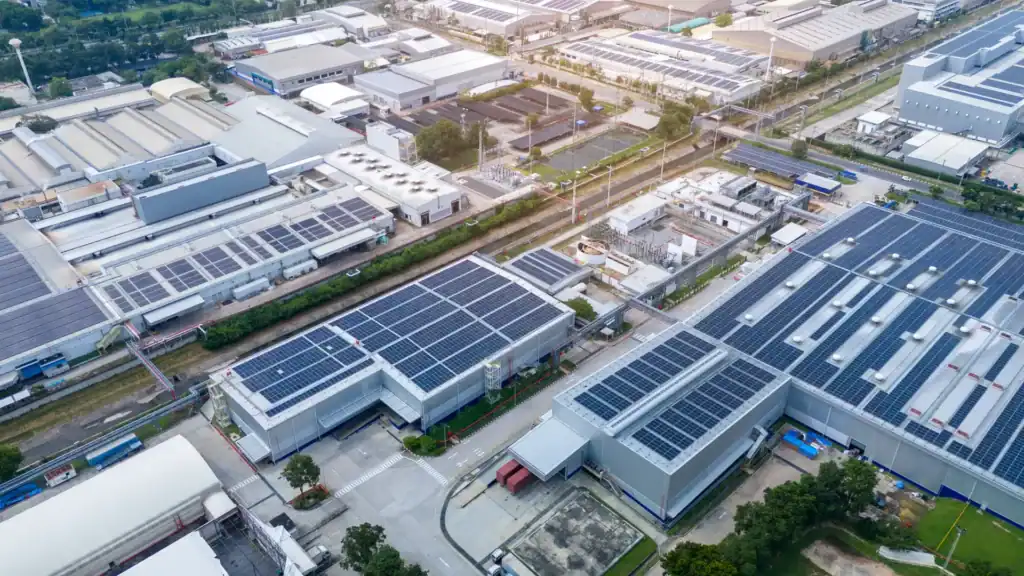
Within an industrial estate, companies do not consume electricity in the same way or at the same times. Some concentrate their activity during the day; others operate in several shifts. One company may have a large photovoltaic roof installation and generate surpluses during certain hours, while another nearby company has high demand precisely at that time.
Some industries have flexible loads that can be shifted over time. Others can provide storage capacity. Certain infrastructures, such as batteries or heavy vehicle charging stations, may be uneconomical at an individual level but make economic sense when shared.
Energy symbiosis consists of identifying and making use of these complementarities.
To do so, it is necessary to jointly analyse hourly consumption curves, electrification forecasts, renewable generation potential, storage capacity, flexible loads and existing electrical infrastructure.
The objective is not necessarily to achieve energy self-sufficiency for the industrial estate. In most cases, it will remain connected to the general electricity system. The objective is to optimise its relationship with the external grid.
An industrial estate may produce enough renewable MWh over the course of a year and still require major grid expansions if all companies concentrate their demand during the same hours. Conversely, joint management of generation, storage and demand can reduce certain peaks and make better use of existing infrastructure.
The issue is not only how much is consumed, but also when it is consumed.
The industrial estate as a local energy system
Traditionally, industrial energy planning is carried out company by company. Each industry contracts power, purchases electricity, may install self-consumption systems and requests its own capacity expansions.
But the industrial estate constitutes a particularly interesting territorial unit. Companies are located close to one another, there is a diversity of activities and, in many cases, there are business associations or management entities capable of promoting collective projects, such as those developed through energy communities in industrial estates. The industrial estate can therefore be conceived as a local energy system. This makes it possible to move from asking what each company needs to analysing how the whole can be managed optimally.
This approach offers several advantages. It makes it possible to make better use of local renewable generation, share assets that would be costly individually, manage demand peaks and provide a more realistic picture of future grid requirements. It can also improve the planning carried out by distribution companies themselves. If the aggregate demand of the industrial estate in five or ten years is known, along with what share can be supplied locally and the maximum power that will actually need to be exchanged with the grid, investments can be sized more accurately.
Royal Decree 640/2026 opens up an opportunity in this regard by incorporating consultation processes to gather the future needs of industry and consumers. For an industrial estate, this makes it possible to present aggregated and forward-looking needs instead of waiting for dozens of individual applications to arise.
Closed distribution networks and energy symbiosis
Energy symbiosis does not necessarily require having a private electricity grid. It can initially be developed through collective self-consumption, energy communities, storage or flexible demand management using existing infrastructure.
However, when the aim is to move towards more integrated energy management, a particularly interesting model emerges: closed electricity distribution networks, regulated in Spain by Royal Decree 314/2023.
These networks make it possible to distribute electricity through privately owned infrastructure within a geographically limited industrial area. It is not simply a matter of sharing photovoltaic installations, but of having a specific distribution infrastructure for the consumers integrated into the network.
From the perspective of energy symbiosis, this makes it possible to consider the industrial estate as a small cell within the electricity system: an internal network where consumers, generation, storage and flexible loads coexist, while also being connected to the public grid. The objective is not to isolate the industrial estate, but to manage internally everything that can be handled more efficiently before relying on external infrastructure.
A closed network does not automatically relieve congestion on the public grid. The effect will depend on how it is designed and operated. But combined with local generation, storage and flexibility, it can help reduce peaks, manage flows more effectively and reduce certain expansion requirements.
Regulatory barriers to the development of closed networks
Despite this potential, closed networks remain exceptional in Spain. One initial explanation is timing. Although the concept already existed in European regulations, the specific Spanish procedure was not developed until Royal Decree 314/2023. But there is a more important barrier: the regulation was not designed with conventional industrial estates made up of numerous independent SMEs in mind.
Royal Decree 314/2023 establishes eligibility conditions that fit particularly well with highly integrated industrial complexes or areas dominated by the same corporate group. Among other routes, the regulation requires either the existence of integrated production processes between companies representing a significant share of consumption, or that the owner or operator of the network and its related companies account for at least 50% of electricity consumption.
This model can work in a chemical or steel complex, or on an industrial campus belonging to the same group. But a conventional industrial estate is different. It may consist of fifty or one hundred independent companies operating in food, metal, plastics, logistics, waste management, workshops or services. These companies may have excellent energy complementarities even though their production processes are not directly integrated. The regulation recognises production integration, but does not recognise energy integration to the same extent.
An industrial estate could demonstrate a high concentration of demand, strong renewable potential, complementary consumption curves, storage capacity, flexibility and capacity problems in the public grid and still fail to meet the requirements to formally become a closed network.
A future regulatory evolution could incorporate functional energy integration as an additional criterion, provided it can be demonstrated that joint management generates verifiable benefits for the electricity system.
The question would no longer be only whether companies have integrated production processes, but also whether it makes sense to manage the industrial estate as a single energy unit.
Governance and collective energy management
There is also another fundamental challenge: governance. An energy symbiosis project requires the coordination of companies with different needs, investments, time horizons and risk profiles.
It is necessary to decide who invests, who owns the facilities, who operates the infrastructure, how costs and savings are distributed, what happens when a company joins or leaves, and what energy information participants must share.
In a closed network, these issues are even more demanding because the owner assumes responsibilities specific to a distribution network operator.
For this reason, the existence of an industrial estate management entity can become a strategic asset. Business associations, urban conservation entities, owners’ associations or energy communities can play an essential role in aggregating demand, collecting data, representing companies and promoting collective projects. In many cases, the first infrastructure required to develop energy symbiosis is not electrical, but organisational.
The El Goro case: an industrial estate-scale energy infrastructure project
El Goro Business Park, in Gran Canaria, provides a particularly interesting example. The SEVI-GoroEco Industrial Energy Community proposes a large-scale project based on renewable generation, storage and its own energy infrastructure for a business park with more than 200 companies.
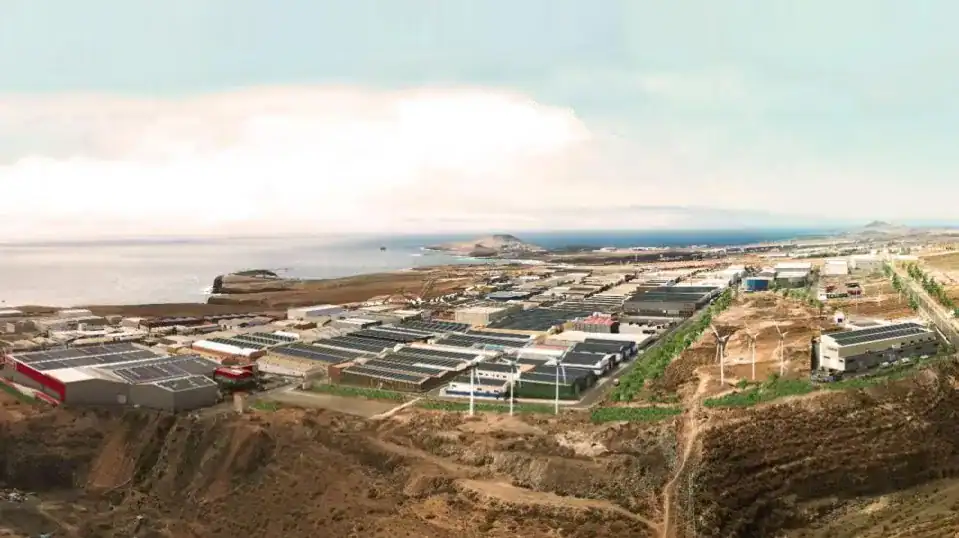
The project documentation includes tens of MW of photovoltaic and wind generation, storage and an internal energy network designed to jointly manage production and demand. The most relevant aspect is precisely this change of scale: instead of each company individually managing its supply and generation, an energy infrastructure is proposed at industrial estate level.
An industrial estate can progressively evolve from individual self-consumption towards shared self-consumption, an energy community, storage, aggregated management and, eventually, its own electricity infrastructure or a closed network where technically, economically and legally viable.
El Goro also shows that common energy infrastructure may require high initial investment, but that this can make sense when spread across significant demand and a lifespan that is not necessarily very long; depending on the type of market involved, the investment can be recovered within a few years.
The economic question should not only be how much the infrastructure costs to build, but what savings, new industrial capacity and renewable energy utilisation it can generate throughout its useful life.
Expanding the grid or using it better: complementary strategies
When faced with electricity capacity problems, there is a risk of presenting two solutions as mutually exclusive alternatives: expanding public grids or internally addressing the needs of industrial estates. In reality, both strategies should progress together.
Industrial electrification will require new investment in transmission and distribution. But a policy based solely on expanding grids may lead to oversized investments if the potential of local generation, storage and flexibility is not analysed at the same time. Before deciding how much a grid should be expanded, four variables should be analysed together:
Future demand + local generation + storage + flexibility.
Planning should therefore evolve from a logic centred on how much new power each company requests towards one based on what the actual energy profile of the industrial estate will be.
Towards industrial estates as energy symbiosis nodes
The energy transition ultimately makes it possible to redefine the role of industrial estates. Historically, they have been regarded as large consumption points to which electricity, gas, water and other infrastructure need to be supplied. In the new energy system, they can take on a much more active role.
An industrial estate can produce renewable electricity, store it, manage part of its demand, share infrastructure, make use of waste heat, integrate electric mobility and participate in flexibility services. In this way, it ceases to be a collection of individual consumers and becomes a local energy node.
This transformation is particularly relevant in a context where the availability of electricity capacity is beginning to determine where new industries can be established and where existing ones can grow. The solution does not consist solely of building more grid infrastructure, nor of trying to make industrial estates independent from the electricity system. It consists of combining grid reinforcement, distributed generation, storage, flexibility and shared energy management. Energy symbiosis provides the framework for doing so.
And closed networks can become one of the tools for developing this model further, provided that the regulatory framework evolves to better adapt to the reality of conventional industrial estates. An industrial estate should not be understood as a collection of independent electricity meters, but as an ecosystem of companies between which there are flows of energy, materials, water and infrastructure.
In the same way that industrial symbiosis seeks to turn waste and underused resources into opportunities, energy symbiosis can transform the diversity of generation and consumption profiles into a collective resource.
The industrial estate of the future will not simply be a large consumer connected to the grid.
It will be a space capable of generating, sharing, storing and managing energy, optimising its relationship with the electricity system while simultaneously increasing its competitiveness and resilience.
Ultimately, the challenge is to move from large consumers to genuine energy symbiosis nodes.