
Verónica Kuchinow. Agricultural Engineer. CEO Símbiosy
Table of contents
- What is a biopark?
- From industrial park to productive ecosystem
- Agro-industrial symbiosis as the logic of the biopark
- From waste management to the creation of new value chains
- What does a biopark offer companies?
- An opportunity to transform the territory
- Plan synergies first, then the land
- What is needed to promote a biopark?
- The role of the public and private sectors
- The facilitator: connecting resources, companies and territory
- Towards a new generation of industrial parks
Bioparks can be much more than a new generation of industrial parks. They can become spaces where agriculture, industry, energy and natural resources are connected to create new value chains based on the circular bioeconomy.
In Spain, we have a significant agri-food, livestock, forestry and industrial sector. This concentration of activities also generates large amounts of organic matter and other resources that can be recovered and put to new uses. At the same time, there is a growing need to find new sources of energy, materials and raw materials, reduce costs and move towards more resilient production models.
In this context, the concept of the biopark is gaining momentum.
But what distinguishes a biopark from a conventional industrial park? And what role can agro-industrial symbiosis play in its development?
What is a biopark?
A biopark can be understood as an industrial ecosystem specialised in the use of renewable biological resources, in which companies, infrastructure and services are organised to generate new value chains from raw materials of agricultural, livestock, forestry or agro-industrial origin.
Its logic is based on the circular bioeconomy and industrial symbiosis: resources that one activity does not need or that have traditionally been considered waste can become raw materials, energy or inputs for other activities.
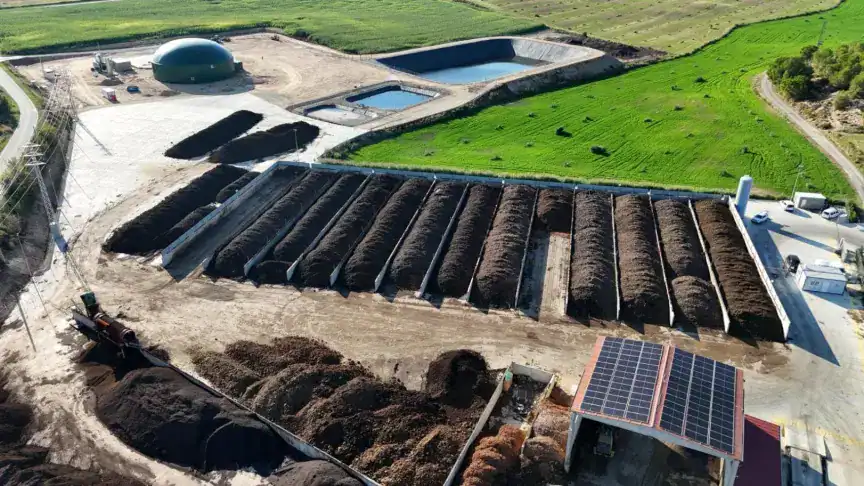
This may include, among other things, the recovery of agri-food waste and by-products, the production of biogas and biomethane, the generation and use of biomass, nutrient recovery, and the production of biofertilisers, biomaterials or higher-value bioproducts.
Therefore, a biopark is not simply a “greener” industrial park.
The fundamental difference is that it does not merely aim to reduce the environmental impacts of the companies located there, but rather seeks to design from the outset the conditions that enable these companies to generate synergies with one another and with the surrounding territory.
It is not simply about sharing a space. It is about sharing resources, infrastructure and opportunities.
From industrial park to productive ecosystem
For decades, we have developed industrial parks with one fundamental question in mind: where to locate companies.
The biopark raises a different question: Which activities should be located together to make better use of the resources available in the territory? This difference is fundamental.
In a conventional industrial park, companies may share a location, but their production processes are essentially independent. In a biopark, by contrast, proximity becomes a tool for creating symbiotic relationships.
One company may find a nearby source of raw materials; another, a buyer for a by-product; several may share treatment facilities, energy storage or water management infrastructure; and new activities may emerge precisely because those resources and connections exist.
Proximity thus ceases to be purely a matter of urban planning and becomes a competitive advantage.
The bioeconomy is the starting point, but the true potential of the biopark lies in combining biomass + energy + water + nutrients + CO₂ + heat + infrastructure + companies. This brings it much closer to an agro-industrial symbiosis ecosystem than to a simple concentration of bio-based industries.
Agro-industrial symbiosis as the logic of the biopark
This is where the relationship between bioparks and agro-industrial symbiosis becomes fully meaningful.
Agro-industrial symbiosis seeks to connect agricultural, livestock, agri-food and industrial activities through the exchange and use of resources.
A simple example might be the following:
Livestock farming → slurry → biogas → biomethane and energy → industry → digestate → fertiliser → agriculture
But the possibilities go much further. Agricultural residues can become raw materials for new industrial processes. By-products from the food industry can feed fermentation processes. Waste heat from one activity can be used by another. Reclaimed water can be reused in industrial processes. Recovered nutrients can return to agricultural land.
The key point is that these relationships are much easier to develop when there is proximity, sufficient volume, shared infrastructure and planning geared towards synergies.
That is why we can say that: Agro-industrial symbiosis defines the relationships and flows; the biopark creates the physical, economic and organisational conditions that allow those relationships to develop.
The biopark would therefore be one of the ways to territorialise and scale up agro-industrial symbiosis.

From waste management to the creation of new value chains
This perspective also changes the way we understand waste. Instead of asking only how to manage a waste stream, we can ask:
What resource does it contain? Who could use it? What new economic activity could be developed from it?
This shift in perspective can turn environmental problems into business opportunities.
A particular type of organic matter may be a cost for the company that generates it, but a raw material for another company. Infrastructure required to manage a waste stream can, in turn, become the core of a new value chain.
In this way, the biopark can act as a hub for resources and companies, facilitating the emergence of businesses that would be unlikely to develop in isolation.
What does a biopark offer companies?
For companies, the specialisation of the site can generate advantages that go far beyond simply having access to industrial land.
These include:

- Access to local raw materials, especially organic resources and biomass.
- Greater security of supply, by organising and concentrating the availability of certain resources.
- Shared infrastructure, such as recovery facilities, energy storage, water management or waste treatment.
- Access to synergistic companies, located within the same value chain.
- Reduced logistics costs, thanks to the proximity between resource generators and consumers.
- Specialised services and facilitation, capable of identifying and developing new synergies.
- Greater attractiveness for investment, thanks to the existence of a previously defined business and infrastructure ecosystem.
- Market positioning, associated with the bioeconomy, circularity and decarbonisation.
Therefore, the appeal of the biopark should not simply be “to set up in a sustainable location”, but rather to become part of (and actively participate in) a business ecosystem that offers opportunities unavailable in a conventional location.
An opportunity to transform the territory
But perhaps the greatest potential of bioparks lies not only in the companies. It lies in the territory.
In many areas, especially rural ones, there are significant agricultural, livestock and forestry resources that currently have limited economic value or generate management costs. At the same time, there are partially occupied industrial parks, available land and economic activities that could generate synergies with one another. The combination of these two elements creates an opportunity.
The biopark can become a tool to attract investment, generate new industry and add value to local resources, transforming environmental problems and management costs into new economic opportunities.
This can help diversify rural economies, create jobs, attract industrial activity and reduce dependence on external resources and energy. Ultimately, it can become a tool for territorial development and reindustrialisation, not merely an environmental policy instrument.
Plan synergies first, then the land
This vision also requires us to rethink how we plan our industrial parks.
In many territories, land designated for industrial use under urban planning regulations does not necessarily meet the needs of new activities linked to the bioeconomy. A biogas plant, a biomass recovery facility or an activity involving the processing of by-products may require different surface areas, access routes, storage areas or planning conditions from those of a conventional industry.
Moreover, if companies are established in isolation, a fundamental opportunity is lost: the possibility of designing synergies before the space is occupied.
For this reason, a biopark should be planned on the basis of the available resources and the business opportunities that can be generated:
What resources do we have?
Which companies generate them?
Which companies could use them?
What infrastructure do we need?
What new activities could emerge?
And what planning conditions do we need to make them possible?
Territorial planning should incorporate these questions from the outset. And this is where tools such as SYNER Platform and its SURPLUS RESOURCE MAPPING service are particularly useful.

What is needed to promote a biopark?
The role of the public and private sectors
A biopark does not emerge simply because land is available. It requires leadership, business vision and coordination.
Public-sector initiative is essential to create the right conditions: urban planning, infrastructure, financing, institutional coordination and support for business establishment.
But a private-sector driver capable of generating economic activity and acting as an anchor for the ecosystem is also necessary.
The proposal must emerge from the territory and be built together with its stakeholders. This is particularly important for generating trust and social acceptance: a project that delivers economic, environmental and social benefits to the territory as a whole is much more likely to obtain the so-called social licence to operate.
And between these two worlds, one particularly important figure emerges: the facilitator.
The facilitator: connecting resources, companies and territory

The complexity of these projects makes it necessary to have a figure capable of connecting the different elements of the system.
A specialised facilitator can identify resources and opportunities, find interested companies, develop synergies, coordinate the different stakeholders, support the definition of infrastructure and assist companies throughout their establishment process.
In a sense, they can act as the “sales representative” of the ecosystem, not simply selling plots of land, but selling the opportunities created by the connections between companies and resources.
They must also be able to work with urban planning departments, public administrations and the bodies responsible for permits and licences, because one of the main obstacles to these projects can lie precisely in administrative complexity.
For this reason, developing a biopark requires both industrial and business “engineering” as well as territorial and institutional “engineering”.
Towards a new generation of industrial parks
Ultimately, the concept of the biopark invites us to change the question. It is not about making industrial parks more sustainable.
It is about designing industrial spaces capable of generating sustainability and competitiveness through the relationships between companies and the resources of the territory.
In this model, organic matter and biomass are no longer seen solely as waste; proximity becomes a competitive advantage; infrastructure becomes a means of connection; and companies cease to be isolated units and become part of a productive ecosystem.
Agro-industrial symbiosis is the logic that makes it possible to connect these elements: the biopark is the space —physical, business and organisational— that can turn them into reality.
And this may be precisely its greatest opportunity: not to build new industrial parks to accommodate companies, but to build industrial ecosystems capable of attracting companies because a system of resources, infrastructure and synergies already exists for them to become part of.
The challenge is not only to produce better. It is to design territories where resources circulate, companies collaborate and environmental problems can become new business opportunities.