

The role of collaboration in industrial symbiosis in stimulating demand and consolidating the secondary raw materials market
Table of Contents
- Industrial symbiosis: collaboration and systems thinking
- The role of industrial symbiosis in waste management
- The secondary raw materials market as a driver of change
- The territorial scale is key
- Symbiosis as a driver of change: where can it make a difference?
- Data as infrastructure for the market
- From recovering materials to building markets
In the circular economy, one of the main objectives is to keep the materials we use circulating within our economy for as long as possible, preserving their value and reducing the need to extract new raw materials.
Much of the effort made over recent decades has focused on improving our ability to recover materials. We have optimised processes, reduced consumption and made better use of resources. We have also developed increasingly sophisticated collection systems, treatment plants, separation technologies and material recovery processes.
These efforts have been enormous and have enabled us to make progress. But it seems we are reaching a point where doing more of the same is no longer enough.
Municipal waste management has struggled for years to progress at the necessary pace and remains far from the target of 65% recycling by 2035. As sorting plants generate approximately 10% rejects, separate waste collection must become more efficient if these recycling targets are to be achieved.
At a global level, the situation is no more encouraging. According to the Circularity Gap Report 2025, only 6.9% of the materials entering the global economy come from secondary sources. More than 93% still follow an essentially linear model of extraction, use and disposal. And the underlying trend is not improving.
We need to “move to the next level”. And to achieve this, simply continuing to improve what we already do is not enough. We need to start doing things differently.
One of the keys may lie in two concepts at the very heart of industrial symbiosis: collaboration and systems thinking.
Industrial symbiosis: collaboration and systems thinking
Through collaboration in industrial symbiosis, we can turn a cost into a business opportunity: transform waste into a resource and make circular economy solutions economically viable when they would never work in isolation.
But these synergies can only be identified and developed through a systemic perspective. Because resources do not exist in isolated compartments. They are part of the same system.
Several companies may generate a material that a third business needs. One industry may produce waste heat that another can use. A wastewater treatment plant may generate resources that can be used in agriculture or industry. Several companies may share storage, treatment or logistics infrastructure.
We need to stop looking only at the end of our own pipe. We need to climb a ladder and look around. Discover who is at the end of the other pipes. Understand which resources some businesses have in excess and which others need.
That is where opportunities emerge that simply do not exist when viewed in isolation.
Collaboration through industrial symbiosis makes it possible to turn a cost into a business opportunity, transform a surplus resource into a raw material for another activity and make circular solutions economically viable when they would never work independently. And this collaboration can only be built through a systemic perspective.
We need to stop managing resources and start managing ecosystems.
The role of industrial symbiosis in waste management
Moving from waste management to resource management requires the systemic perspective discussed earlier. We need to move from managing waste to managing ecosystems: understanding companies’ material flows — their inputs and outputs — and identifying new opportunities between them that make solutions with a positive impact viable, both for the businesses driving them and for the territories in which they operate.
Industrial symbiosis can operate particularly effectively at two key points in waste management: material outputs, meaning waste and surplus resources that can potentially be recovered, and material inputs, including secondary raw materials or recycled materials.
Regarding material outputs, industrial symbiosis makes it possible to identify and locate companies generating similar waste streams and bring them together, facilitating shared solutions and improving the viability of reverse logistics and material recovery.
Think about our current linear economy. We extract materials concentrated in mines, which supply an ever-growing number of processing industries. From there, these materials are distributed throughout the economy until they reach hundreds or thousands of consumers. And then we expect to recover them!
We need to be able to identify where they are, in what quantities and with what characteristics, and then concentrate them again. Ultimately, this is also a problem of dispersion and logistics. A problem of entropy.
This is where collaboration through industrial symbiosis becomes particularly effective. It enables the creation of new business models that make transport, infrastructure investments, the necessary technological processes and other solutions viable when individual companies would lack the scale or profitability to implement them alone.
The secondary raw materials market as a driver of change
For years, our efforts have focused primarily on increasing the supply of recovered materials: collecting more, improving separation, recycling more and obtaining higher-quality secondary materials.
All of this remains necessary. But improving supply does not guarantee that demand exists.
When a recycling company produces a secondary raw material, it often competes with virgin raw materials that benefit from established markets, known specifications, existing supply chains and prices that do not always reflect their environmental impacts.
The result is a paradox: we may have technically recoverable materials that end up having little economic value because there is insufficient, stable and predictable demand.
Therefore, developing a secondary raw materials market requires working simultaneously on two fronts: the supply of recovered materials and the demand capable of absorbing them.
Until now, we have not paid enough attention to this second dimension, even though it could become an effective tool for stimulating recovery.
Because demand may be precisely the driving force we need to increase material recovery: if a company is willing to purchase a particular secondary material, an incentive will emerge to recover and manage it properly. If demand is stable and sufficient, it can justify investment in new collection, sorting, treatment or processing infrastructure.

And the effect may go even further: if we know there is a market for a particular material, the companies generating it will have incentives to redesign their processes so that their surplus resources can be recovered and meet the specifications demanded by that market.
Demand can therefore act as a lever for transforming the entire value chain.
The territorial scale is key
Systems thinking and the territorial scale raise a key issue for these markets to function: the concentration and continuity of resources.
A single company may generate an insufficient volume to justify a particular recovery operation. However, dozens of nearby companies may be generating similar materials.
Likewise, an industry may have substantial demand that no single supplier is capable of meeting.
The territorial scale makes it possible to connect these two realities.
Within a district, industrial area or region, we find companies consuming raw materials, businesses generating surplus resources, waste management and recycling companies, treatment facilities, logistics providers, technology centres and public authorities.
The challenge is to connect these elements to build value chains that are sufficiently large, stable and competitive.
Industrial symbiosis has a particularly important role to play here.
Symbiosis as a driver of change: where can it make a difference?
As we have seen, industrial symbiosis can become a powerful driver for activating these markets by working on different elements of the system.
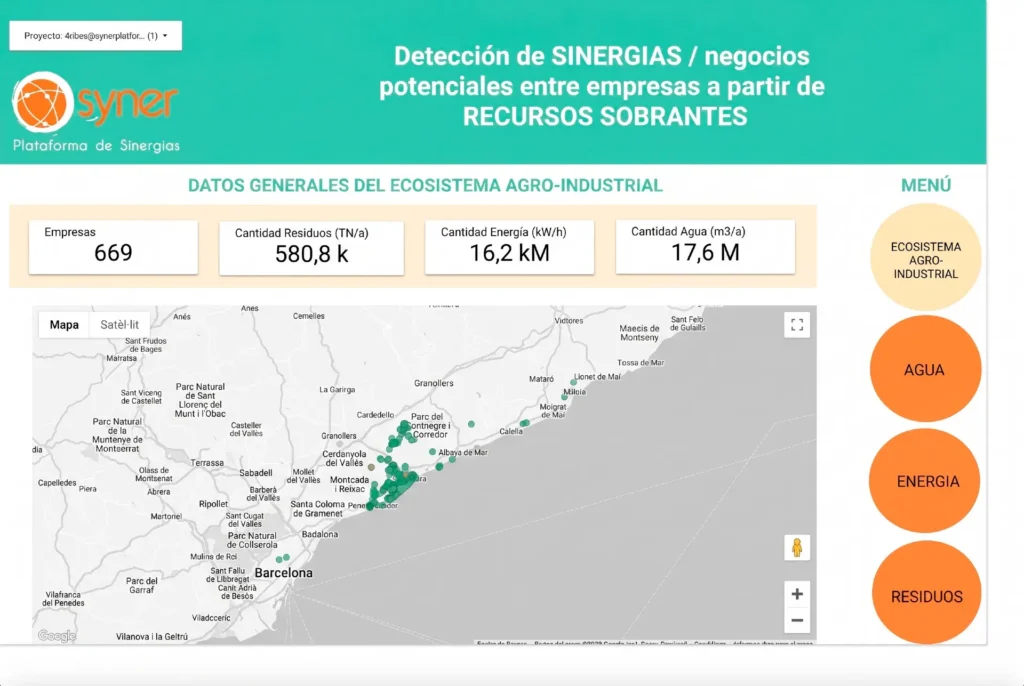
First, by identifying and mapping resources.
We need to know which surplus materials exist, who generates them, in what quantities, with what characteristics, where they are located and how they evolve over time.
But we also need to map demand: which companies consume raw materials, which could incorporate secondary materials and what requirements those materials would need to meet.
Second, by aggregating supply and demand.
Concentrating resources and needs can make solutions viable that would not be feasible for a single company. Aggregating material flows makes it possible to reach sufficient volumes and reduce collection, transport and treatment costs.
Third, by identifying the necessary infrastructure.
A circular value chain needs much more than a producer and a consumer. It may require dedicated collection, reverse logistics, storage, sorting, pre-treatment, processing or new recovery facilities.
Fourth, by designing collaborative solutions.
Sometimes the solution is not simply to connect two companies, but to jointly develop new infrastructure, share an investment, adapt processes or create a new business model.
And fifth, by facilitating relationships.
Systemic projects are complex. They involve numerous stakeholders with different interests, knowledge, languages and capabilities. Collaboration does not happen automatically just because two points appear connected on a map.
Someone needs to help build the relationship, assess feasibility, identify barriers and support the stakeholders until an opportunity becomes a real project.
Data as infrastructure for the market
Throughout this process, digitalisation can play a fundamental role. Because effective management requires information. It requires data.
Resource mapping provides a territorial overview of supply and demand and helps identify opportunities that would be difficult to detect from an individual perspective. But the real value lies in turning this data into decisions.
Which materials should we prioritise? Where is there sufficient supply? Which sources of demand could be activated? Which stakeholders should we connect? What infrastructure is missing? Which opportunities have enough potential to become projects?
In industrial symbiosis, these mapping exercises are essential, and digital tools exist that make the process much faster and more efficient. Some even allow us to work with estimated data, which is particularly important because access to real data is often limited. Platforms such as SYNER use estimated data derived from statistical analysis, big data and artificial intelligence, making it possible to map resources and opportunities across different territories and ecosystems.
Data is the intangible infrastructure not only of industrial symbiosis, but also of efficient resource management.
Of course, mapping and data availability are only the first step: they provide an overall picture to support decision-making. But they can never replace the collaboration and facilitation that are so essential to implementing solutions and making things happen.
From recovering materials to building markets
Developing an established market for secondary raw materials does not depend solely on achieving higher recycling rates.
It requires buyers, demand, quality, continuity, logistics, trust and infrastructure. And it requires all these elements to develop together.
Perhaps, then, the next major step in circular economy policies should not simply be to ask how we can recover more tonnes of materials, but also:
What demand can we stimulate to ensure those tonnes have a market?
The answer requires working at the territorial level and across the entire value chain. It involves connecting companies that generate and consume materials, waste managers, recyclers, technology providers, infrastructure operators and public authorities. And it requires a systemic perspective.
Industrial symbiosis can provide the collaborative environment where all these elements come together.
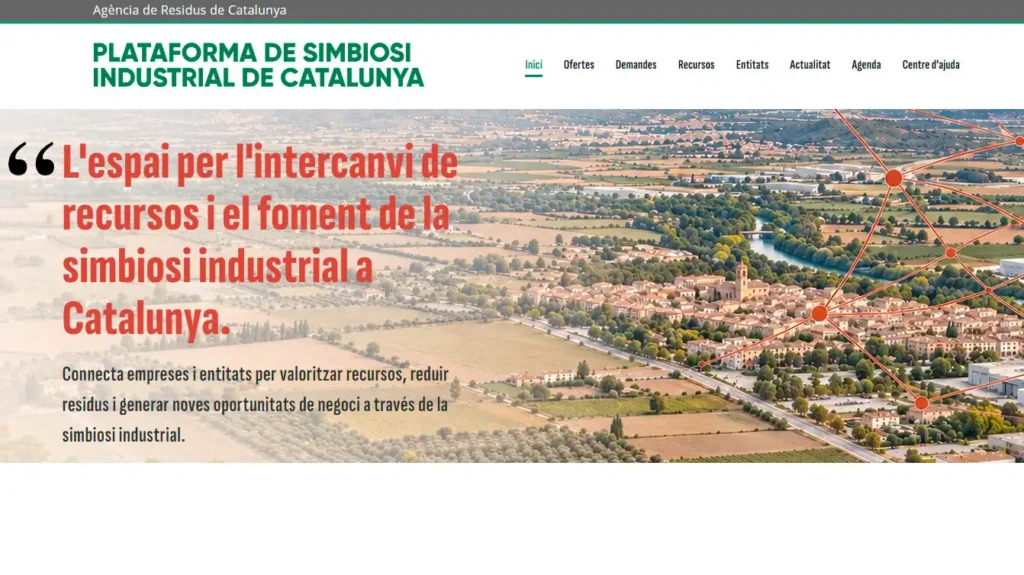
The Industrial Symbiosis Platform of Catalonia (PSIC), whose objective is to facilitate resource exchanges between companies and organisations, is already beginning to explore how to use this capacity to connect stakeholders to address the challenge of stimulating demand: aggregating resources, identifying the necessary infrastructure and developing secondary raw material supply chains capable of competing with conventional ones.
It is a long journey, and there is still a great deal of work to be done. But we need to get started. And at some point, we have to take the first step.
Let’s get to it!